
There's nothing worse than watching your players trudge through another lifeless shooting drill. You know the one: a queue of kids waiting for ages, half-hearted shots dribbling towards goal, and that glazed-over look that says "when's this over?" Bad soccer shooting drills don't just waste time — they actively undermine finishing confidence.
The best shooting drills don't feel like drills at all. They feel like games. They're competitive, high-energy, and — most importantly — players actually want to do them again next week.
This guide collects 15 fun soccer shooting drills across three age groups: U7–U9, U10–U12, and U13–U16. Each drill includes a clear setup, how to run it, why players respond to it, and key coaching points you can use on the day. Every one of these can also be generated with personalised coaching points, progressions, and regressions in seconds using CoachAI's Session Generator.
What Makes a Great Soccer Shooting Drill?
Before the drills, it's worth understanding the three qualities that separate an exercise players remember from one they endure:
- Competition: whether it's against teammates, the clock, or themselves, competition creates the pressure that mirrors match situations. Players who only shoot in low-stakes queues never develop composure in front of goal.
- Variety: different angles, distances, and movement patterns engage the brain and build a wider technical toolkit. A player who has only ever shot from straight ahead will hesitate when a chance arrives from a wide angle.
- Game-realism: the best finishing drills put players in recognisable match scenarios — a ball played into stride, a cross to meet, a 1v1 to beat. Skills rehearsed in realistic contexts transfer to Saturday mornings; skills rehearsed in isolation often don't.
Every drill below scores well on all three. Let's get into them.
Fun Soccer Shooting Drills for Younger Players (U7–U9)
With younger age groups, simplicity is king. These football shooting drills for kids focus on high repetition, minimal waiting, and maximum fun. The coaching objective at this stage isn't technical perfection — it's striking the ball with confidence and celebrating like they've scored the World Cup winner.
1. Knockout Shootout
Setup: One goal, 6–8 players, one ball each. Players line up 10 metres from goal.
How it works: On the whistle, everyone shoots at once. Score and you're safe for that round. Miss and you're knocked out. Last player standing wins.
Why players love it: Pure chaos — the good kind. No waiting, instant feedback, and that competitive edge that gets young kids fired up immediately.
Coaching points: Encourage players to look up before they shoot. Celebrate good technique as well as goals — a clean strike that misses the target is worth acknowledging.
Progression: Introduce "weak foot only" rounds once they've got the hang of it, or add a 3-second countdown to increase pressure and urgency.
2. Target Practice Frenzy
Setup: Place 4–5 mini targets (cones, flat markers, or pop-up goals) inside a larger goal. 15m × 15m area with a supply of balls.
How it works: Players get 60 seconds to hit as many targets as possible. Each target is worth different points based on difficulty — corner targets score higher than central ones. Track scores and run multiple rounds.
Why players love it: It's basically a fairground game. They'll be sprinting to reload faster than you can reset the targets.
Coaching points: Focus on aiming — where the non-kicking foot is pointing often determines where the ball goes. Keep it light and encourage them to "pick their target" before each shot.
Progression: Move the targets back to increase distance, or add a rule that players must dribble from a cone 10 metres back before they can shoot.
3. Beat the Keeper Race
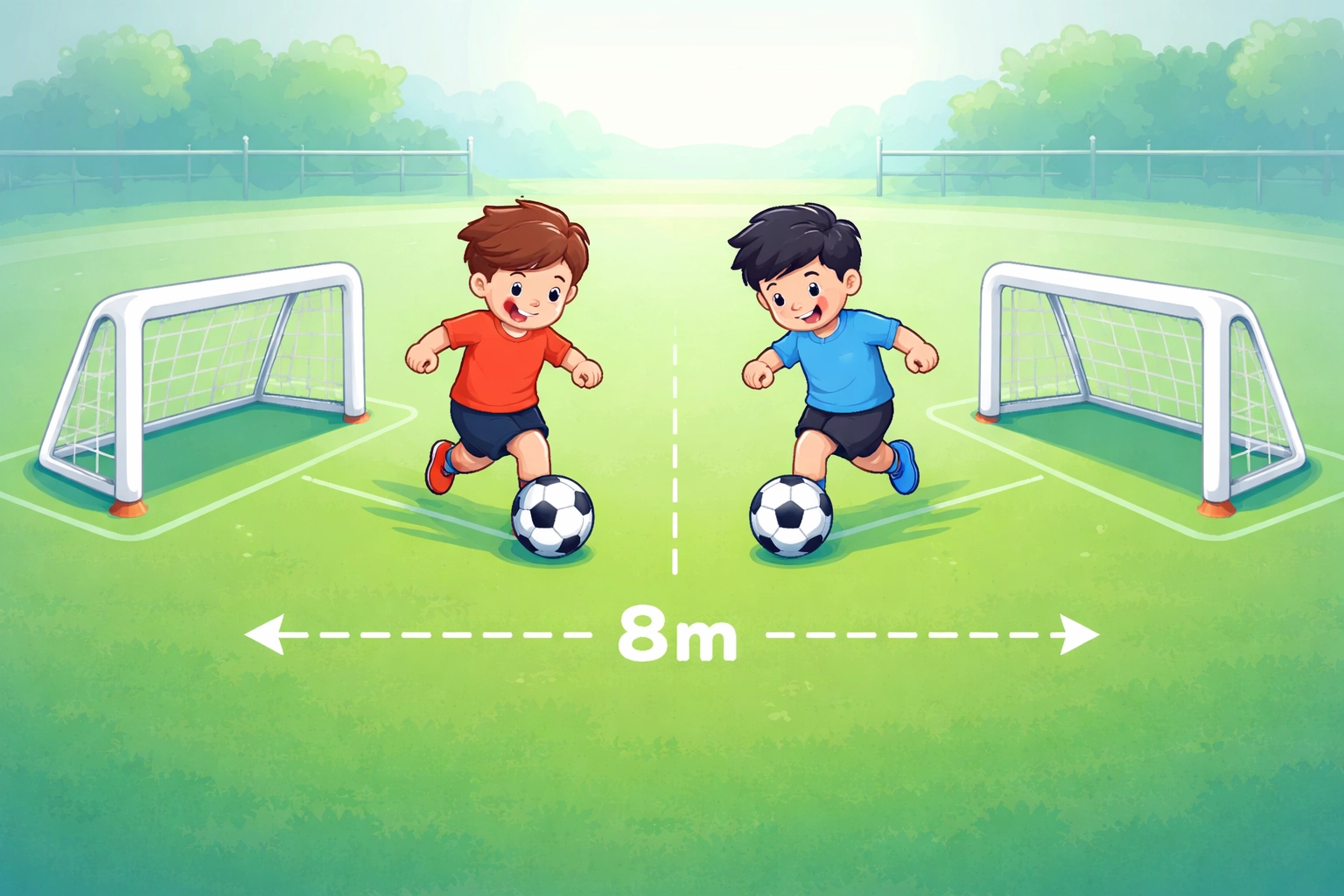
Setup: Two mini goals side by side, 8 metres apart. Two shooters, one ball each, shooting at the same goal simultaneously (no keeper needed — the goals are small).
How it works: First player to score 5 goals wins. If both score simultaneously it doesn't count — go again. Run tournament brackets if you have enough players.
Why players love it: Head-to-head competition is irresistible at this age. Even the players waiting their turn are invested, watching and cheering.
Coaching points: Don't overload them with technique here — let them find their own solutions. Observe who's shooting with their laces versus their toe and address it gently in a separate context.
4. Traffic Light Finish
Setup: Coach stands near the penalty spot with three coloured cones (red, amber, green). Players dribble from 20 metres out towards goal.
How it works: As players approach, the coach calls out a colour. Green = shoot immediately. Amber = one more touch, then shoot. Red = stop the ball dead, then shoot from the spot.
Why players love it: The unpredictability keeps them alert and thinking. They feel clever when they react quickly to the right signal.
Coaching points: Watch their head position as they approach — players who are looking down at the ball will miss the colour call. Encourage them to keep their head up while dribbling.
Progression: Call colours earlier or later to vary the challenge, or add a fourth colour that means "turn and go back."
5. Treasure Hunt Goals
Setup: Scatter 6–10 balls randomly across half the pitch. One full goal with a keeper.
How it works: On the whistle, players race to find a ball and score. First to 3 goals wins. Balls can't be stolen once someone is dribbling with them.
Why players love it: The scramble to find "their" ball adds an adventure element that younger players absolutely adore. It never feels like training — it feels like a game they invented themselves.
Coaching points: Minimal coaching during the drill — let it run. Afterwards, ask players what decisions they made: "Why did you go for that ball and not the nearer one?"
Soccer Shooting Drills for Intermediate Players (U10–U12)
Now we're adding combinations, angles, and decision-making. These football finishing drills build technical foundations — first touch, striking technique, hip positioning — while keeping that competitive spark alive. Players at this age are ready to understand why they're doing what they're doing, so brief coaching points land well.
6. Flying Changes
Setup: Players line up at one goalpost, facing parallel to the goal line. Full-size goal with keeper.
How it works: Player takes one touch flat across the goal-face, then strikes at a 90° angle into the far corner. After 5 minutes, switch sides to work the opposite foot.
Why players love it: It looks and feels like a "proper" finishing move. The rhythm of touch-and-strike is deeply satisfying once they nail it.
Coaching points: Emphasise opening the hips early on the first touch so the body is already turned for the shot. The non-kicking foot should point at the target. Watch for players dragging the ball across and rushing the finish — slow it down initially, then build pace.
Progression: Add a server who feeds the ball from outside the box so the player must control it first before executing the flying change.
7. 1v1 Diamond Shooting
Setup: Diamond shape with cones (15m × 15m). Attacker starts at the top, defender at the bottom, goal behind the defender.
How it works: Attacker receives a pass and must beat the defender 1v1 to finish. If the attacker misses the target, they become the keeper for the next round.
Why players love it: The "miss and you're in goal" rule adds real stakes without being harsh. Players learn quickly that missing is costly — which is exactly the composure lesson you want them to internalise.
Coaching points: Encourage attackers to commit the defender before shooting — don't shoot from distance unless the angle is good. Shoot early when the goalkeeper is off their line; hold if the angle is tight and an extra touch can open it up.
8. Touch and Stride Finish
Setup: Server or rebounder positioned 10 metres to the side. Shooter starts centrally, 18 metres from goal.
How it works: Ball is played into the shooter's path at an angle. First touch sets it forward into stride, second touch finishes. 10 reps each foot, then rotate.
Why players love it: It replicates those match moments where a through ball drops perfectly into your stride. When the two-touch combination clicks, the ball flies in with real quality.
Coaching points: The quality of the first touch is everything here. A heavy touch produces a rushed shot under no pressure; a controlled touch produces a composed finish at full stride. Direct players' attention to what the first touch is doing, not just the finish.

9. World Cup Tournament
Setup: Split into pairs or threes. One full goal, rotating keeper.
How it works: Classic knockout format: teams play first to 2 goals, losers are eliminated. Final pair battles it out. Eliminated players become keepers or feeders to keep everyone active.
Why players love it: It's a staple for a reason. The tournament bracket creates natural drama, and players care about the outcome in a way that pure repetition drills never achieve.
Coaching points: Use the moments between rounds rather than interrupting play. After a goal, ask the scorer: "What created that chance?" After a miss, ask: "What would you do differently?"
Progression: Restrict touch count (two-touch only), or introduce a rule that goals from outside the box count double to encourage long-range attempts.
10. Angled First-Time Finish
Setup: Server positioned wide, near the corner of the penalty area. Shooter makes a curved run into the box from a central starting position.
How it works: Ball is played across the box. Shooter must finish first-time. Work both sides, 10 reps per foot.
Why players love it: First-time finishes feel clinical and professional. When they connect cleanly, they know it — and so does everyone watching.
Coaching points: The run into the box matters as much as the finish. Encourage an arcing run so the player arrives side-on to the ball with their hips open. A straight run produces a scuffed finish or a blocked shot — a curved run creates the angle for a clean strike.
High-Intensity Shooting Drills for Older Players (U13–U16)
At this stage, we're adding game-realism, transitions, and pressure. These football shooting drills for older youth players prepare them for the decision-making demands of competitive matches — where they need to recognise when to shoot, when to pass, how to create space, and how to finish under physical and time pressure.
11. 3-Tier Shooting Circuit
Setup: Shooting line in the centre (20m out), two passing lines on the end line (wide positions). 12–15 players ideal, with balls at each station.
How it works: Player 1 shoots from the central position, sprints wide to receive a pass and finish from an angle, then attacks a cross from the opposite wide line. Three different finishing scenarios in one continuous rep. Rotate clockwise every 5 minutes.
Why players love it: Three distinct finishing scenarios in one rep. It's physically demanding but deeply rewarding when all three connect cleanly.
Coaching points: Each tier has distinct technical demands. Central shot: body shape and strike technique. Angled finish: first touch across the body. Cross: arrive early and attack the ball rather than waiting for it to drop.
12. 4v2 Attack to Goal
Setup: 30m × 20m area. Four attackers versus two defenders, one full goal with keeper.
How it works: Attackers must create a shooting opportunity within 15 seconds. Emphasis on quick combinations and recognising when to shoot versus when to pass. If defenders win possession, the attacking group immediately defends a mini goal to keep the drill competitive.
Why players love it: The numerical advantage means they should score — but the time pressure forces quick thinking and punishes hesitation.
Coaching points: Watch for players who keep passing when a clear shooting opportunity exists. Reinforce the principle: if you can see the goal and you're in range, shoot. Also watch for the opposite — players shooting when a simple pass creates a better chance.
Progression: Reduce the time limit to 10 seconds, or add a third defender to raise the challenge.
13. 1v1 50/50 to Goal Competition
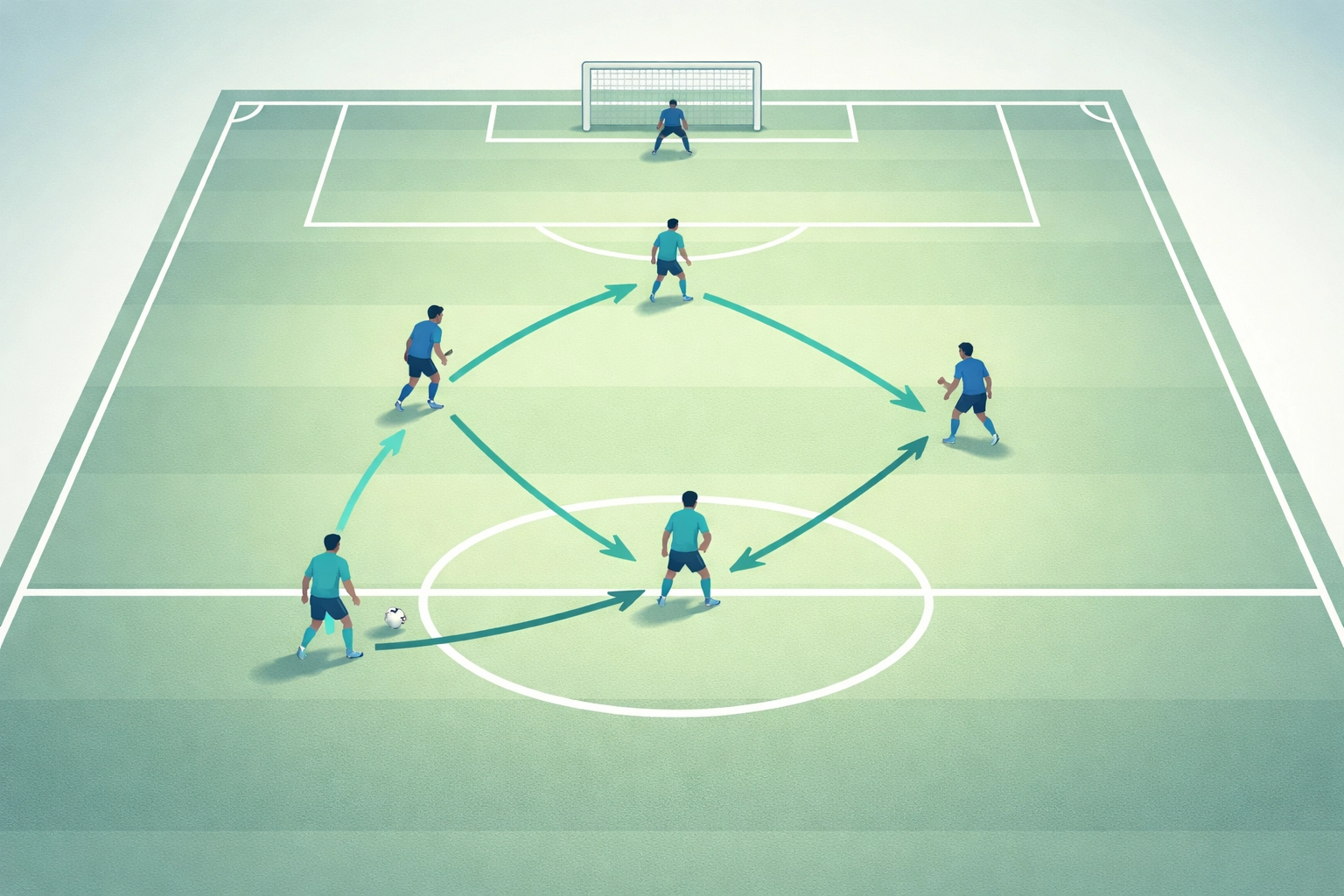
Setup: Two players start on opposite sides, each 15 metres from a central ball. Full goal with keeper behind one player's starting position.
How it works: On the whistle, both players sprint to win the central ball. Winner attacks the goal, loser defends. First to 5 goals wins the tournament bracket.
Why players love it: Raw and competitive. It tests fitness, determination, and composure in front of goal simultaneously.
Coaching points: The technical focus here is finishing under pressure — the attacker has won the ball, but there's a recovering defender. Encourage early shots when the angle is good rather than attempting to beat the defender a second time.
14. Attack vs Defence Waves
Setup: Three attackers start on the halfway line, two defenders on the edge of the box. Full goal with keeper, plus a mini goal on the halfway line for defenders to counter-attack into.
How it works: Attackers have 10 seconds to score. If defenders win the ball, they immediately counter-attack to the mini goal on the halfway line. A fresh wave of attackers enters every 20 seconds — relentless pace throughout.
Why players love it: The relentless tempo replicates real match intensity. There's no time to switch off, and both attackers and defenders are fully invested in every rep.
Coaching points: For attackers: get a shot off quickly — the 10-second limit rewards directness. For defenders: stay compact and force the ball wide; don't dive in.
Progression: Reduce from 3v2 to 2v2 to increase defensive pressure, or award defenders a bonus point for each successful counter-attack to keep them motivated.
15. Transition Shooting Game
Setup: 7v7 on a 40m × 30m pitch with full goals at each end.
How it works: Normal game with one rule change: goals only count if scored within 8 seconds of winning possession. This rewards quick transitions and direct finishing — teams that recycle possession slowly score nothing, no matter how much they dominate.
Why players love it: It rewards the aggressive, front-foot mentality that produces match-winners. Players quickly learn to spot the moments when a fast transition is on, and the game generates a higher shot volume than any standard training match.
Coaching points: After the session, discuss: "When were we winning the ball in good positions? What did we do with it?" Help players connect the in-session habit to the match context.
How to Structure a Shooting Session
Running these drills effectively is about more than picking a favourite and hoping for the best. A well-structured shooting session typically follows this shape:
- Warm-up with the ball (10 min): Rondos, passing combinations, and light dribbling to get players moving and comfortable on the ball. Keep it dynamic and with a ball wherever possible. See our guide to structuring a session from warm-up to reflection for a full breakdown.
- Technical drill (15 min): Choose one drill that isolates a specific finishing technique — Touch and Stride Finish, Flying Changes, or Angled First-Time Finish work well here. High repetition, minimal competition pressure, focus on quality of execution.
- Competitive drill (15–20 min): Move to a competitive game-like exercise — Knockout Shootout, 4v2 Attack to Goal, or Attack vs Defence Waves. Transfer the technical focus from the previous drill into a pressured context.
- Small-sided game (15 min): Finish with a game that brings everything together — the Transition Shooting Game is ideal, or a standard small-sided match where you reinforce the technical points from earlier.
- Reflection (5 min): A quick group debrief. One or two questions is enough: "What did we do well? What do we want to improve?"
Keeper-Involved Finishing: Don't Neglect Your Goalkeeper
One common oversight in shooting sessions is treating the goalkeeper as a passive obstacle. Your keeper benefits just as much from high-volume shot-stopping as your outfield players do from finishing repetition. A few simple adjustments make your shooting drills work harder for everyone:
- Vary the service angle so the keeper isn't always set for the same shot. Crosses, cut-backs, and driven balls through traffic all demand different positioning.
- Give the keeper a target to counter-attack to after making a save — it builds distribution habits and keeps them engaged between shots.
- Rotate keepers regularly in drills like Knockout Shootout and World Cup Tournament so no single player stands in goal for too long.
If you use CoachAI's Session Generator, keeper-specific coaching points are included automatically when you select a goalkeeper objective alongside your outfield focus.
Five Coaching Habits That Improve Shooting Sessions
- Keep queues short or eliminate them entirely. If players are standing in a line for more than 30 seconds, restructure — run two goals simultaneously, or split the group into smaller pods.
- Praise the process, not just the outcome. "Great technique" when a player strikes well but misses builds more long-term confidence than only celebrating goals.
- Introduce pressure gradually. Start technical drills slowly and without defenders, then add pace, then add competition. Don't open with full pressure and wonder why technique breaks down.
- Ask questions rather than giving instructions. "Where was your standing foot?" teaches more than "Put your foot next to the ball." Questions build self-awareness that persists beyond the session.
- Use weak foot rounds regularly. Players won't naturally practise their weaker foot unless you build it into the drill structure. Add weak-foot requirements to any drill — it takes one sentence and makes a significant long-term difference.
Generate These Drills with CoachAI's Session Planner
Every drill in this list can be generated inside CoachAI's Session Generator — with coaching points, KPIs, progressions, and regressions tailored to your age group, squad size, and available equipment. Instead of planning from scratch, you describe the focus (finishing, transitions, 1v1s) and the AI builds the full session structure around it.
Each generated session includes:
- Personalised coaching points — so you know exactly what to say and when
- Measurable KPIs — to track whether it's working
- Progressions and regressions — so you can adapt instantly if the drill is too easy or too hard
- Warm-up and reflection structure — the full session, not just the drills
The Session Generator is available on the free plan — no credit card required. Check our pricing page to see what's included. If you're running a club and want every coach planning at the same standard, our Club & Academy plan gives all your coaches access to the full toolkit.
Frequently Asked Questions
How many times a week should I do shooting drills with my team?
For grassroots and youth teams training once or twice a week, aim to include a dedicated shooting or finishing block in at least one session. Even 15–20 minutes of focused soccer shooting drills, done consistently, produces noticeable improvement in finishing confidence over a season.
What are the best soccer shooting drills for young kids (U7–U9)?
For U7–U9 players, the best shooting drills are simple, competitive, and high-repetition. Knockout Shootout, Beat the Keeper Race, and Treasure Hunt Goals all work particularly well — minimal waiting, instant feedback, and a game-like feel that keeps young players engaged from first whistle to last.
How do I stop players queuing during shooting drills?
Run multiple stations simultaneously. Drills like Beat the Keeper Race (two goals side by side) or the 3-Tier Shooting Circuit (multiple finishing lines running at once) keep all players active at the same time. As a rule, no player should be standing still for more than 30 seconds during a shooting block.
Can I use these shooting drills for small-sided or 7v7 teams?
Yes. Most of these drills scale to small-sided formats easily. For 7v7 teams, the U7–U12 drills work without modification. For the older-player drills, reduce the pitch size and player numbers proportionally — a 4v2 Attack to Goal works just as well in a tighter space with fewer players.
How do I generate personalised coaching points for these drills?
CoachAI's Session Generator can produce any of these drills — and hundreds of others — with personalised coaching points, progressions, and regressions tailored to your age group, squad size, and available space. It takes under a minute and is available on the free plan.
Ready to build these into a full session? Read our guide to structuring a session from warm-up to reflection, or head straight to CoachAI's Session Generator to build a bespoke shooting session for your squad in under 60 seconds. See our pricing page to get started — the Session Generator is free.
Back to Blog